Leading AI Transformation
Creating Flatpay Lab, a shared system for customer signal, coded prototypes and product context across the organization.
- Role
- Director of Product Strategy & UX
- Year
- 2026 — Present
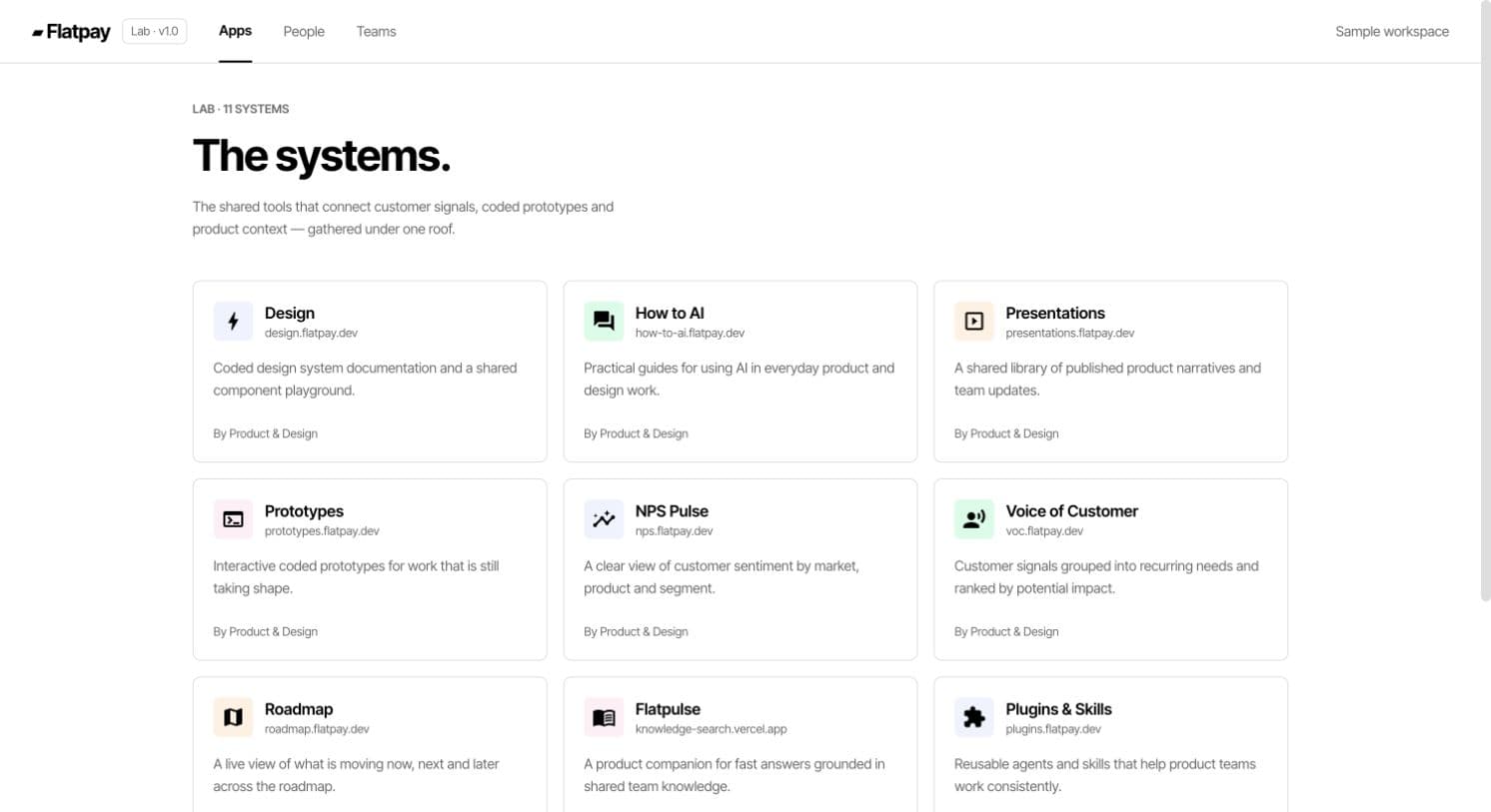
Flatpay Lab grew out of a practical problem. AI initiatives were already changing how we worked across Product and Design, but each lived on its own. The opportunity was not another collection of experiments. It was to organize them into a system that could connect how the product organization learns, decides and builds.
The need was clearest in the volume of customer signal we receive. Support calls, retention conversations, sales visits, NPS responses, BI and PostHog all tell us something useful. Looking at each hunch individually does not scale. Lab gives those signals a common place to become evidence, then puts the highest-impact needs in front of product managers while there is still time to act on them.
From signal to a product decision
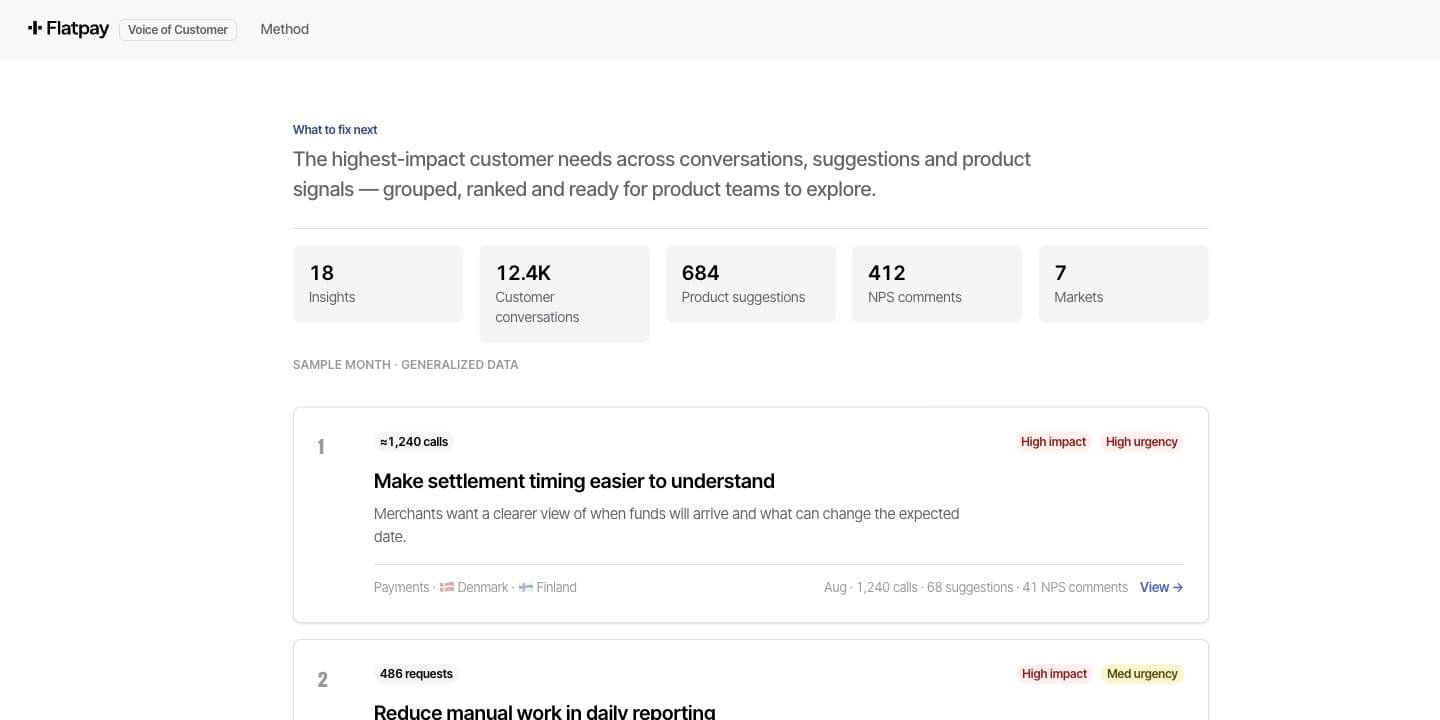
Voice of Customer automates the work between raw feedback and product attention. Its current synthesis spans more than 284,000 support calls from January through July, alongside hundreds of product suggestions, NPS comments and retention records. It clusters related needs, ranks them by impact and urgency, and keeps the source context attached. Product managers can see patterns across markets instead of reviewing one channel at a time.
That changes the unit of analysis. We can move from debating isolated anecdotes to examining recurring needs across a large customer base. The model does not make the decision. It gives the team a much better surface on which to make one.
Design moved into code
During Flatpay's hackathon in May, I built the first version of the coded design system and the prototyping environment. We had been using Lovable to move quickly, but it separated prototypes from the real product language. The replacement connects our Figma components to a fully realized code system, so designers can work with Claude Code using the same components, tokens and patterns engineering will eventually see.
The design system now documents more than ninety foundations, content rules, components and patterns. By August, the catalog held fifteen published prototypes from eight contributors, including designers and product people beyond me. A prototype can begin inside the real system, become interactive before a handoff, and return to Figma with its tokens intact.
AI across the design cycle
Our design process still moves through divergence and convergence; AI changes the range and speed of each stage. During research, Claude Code can use Mobbin to benchmark a pattern across the fintech B2B products on our competitor list. For a date picker, for example, it can find comparable implementations and turn them into an interactive report explaining the functional differences, trade-offs and fit for Flatpay's customers and use cases. That gives the team a wider field of evidence before we narrow toward a solution.
In design and prototyping, we use that evidence alongside a Linear ticket, requirements document or an existing prototype. Claude Code can extend a component, generate a Figma direction or build an interactive version using the real design system. The output is not the decision; it is material the designer can question, compare and refine. Moving between a written requirement, a design and working behavior makes important states and assumptions visible much earlier.
As the work converges, AI becomes a critic and quality layer. We run heuristic reviews against our ideal customer profile to find usability issues and opportunities we may have missed. Design QA checks Figma files for incorrect tokens and styles, accessibility problems, inconsistent component usage and drift. Technical QA exercises a component in context across states, variants, properties and API responses, then reports broken or missing behavior and can turn the findings into Linear tickets.
The same context carries into documentation and implementation. AI can draft component guidance from its properties, dependencies, tokens, use cases, examples, caveats, version history and the decisions behind it. With the production codebase connected, it can also create or refine components and submit a pull request for review. That makes small craft improvements—animation timing, token corrections or a brand-wide change to type, radius or colour—practical for designers to carry through to code without removing engineering review.
The economics are already visible
The Lab UI projects create approximately €150,000 in annual direct savings. Roughly €50,000 comes from replacing SaaS products with tools built around Flatpay's workflows. Another estimated €100,000 comes from design-system and frontend engineering efficiency: fewer duplicated components, less translation between Figma and code, and faster production of working prototypes.
The larger effect is harder to put in a budget line. By connecting existing BI, PostHog, customer support and retention systems more directly to product work, customer needs and pain points reach the people making roadmap decisions sooner and with more evidence attached. The tools already existed; the gain comes from making them operate as one learning system.
A specialist in every conversation
Product Assistant turns repeatable expertise into nine specialists that can join a product person's daily work: data, research, strategy, design, product management, marketing, engineering, people and QA. Each works from the same Flatpay context the team uses, so the conversation begins with our strategy and product language instead of generic advice. How to AI makes the workflows legible, from asking a product question to building a prototype or analyzing a dataset.
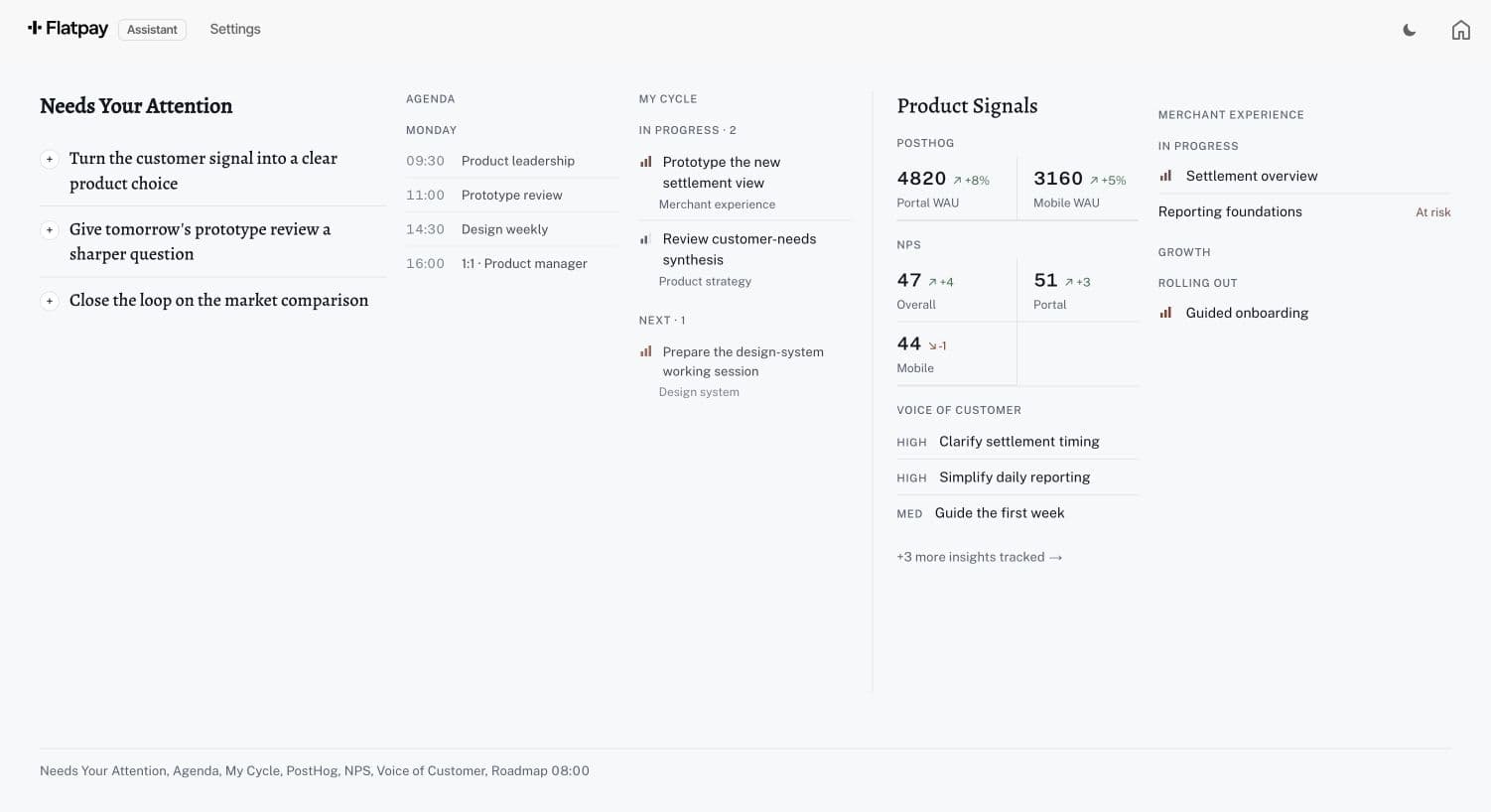
Executive Assistant applies the same principle to attention. It assembles roadmap signals, agendas, 1:1 commitments, calendar context and product data into a daily view of what matters. Competitive Intel does it for the market, turning a stream of competitor activity into recurring research and product implications. The common idea is simple: give every product person the context a good manager carries and a sparring partner in every product discipline.
The next boundary is organizational
Executive sponsorship made room for the work, while interviews with product managers and designers kept it grounded in real jobs. The next constraint is not model capability. It is the partnership and governance required to move prototypes safely into production without turning exploration into shadow engineering.
That means clearer interfaces between Product, Design and Engineering, shared standards for review, and an explicit boundary between a prototype and shipped software. The Lab has made more people capable of exploring, synthesizing and building. The next step is making that capability part of how the organization works together.