From Series A to unicorn
Scaling Flatpay's product and design organisation from 10,000 to 100,000 merchants across six countries.
- Role
- Director of Product Strategy & UX
- Year
- 2023 — Present
When I joined Flatpay, the product organisation had to grow at the same pace as the business. In three years, Flatpay grew from 10,000 to 100,000 merchants and expanded into six countries. The work was not simply adding people or shipping more features. It was building the product, design and operating systems that could support growth without turning every decision into a dependency on a few people.
I supported the CPO as a sparring partner on product vision and strategy, helping explore potential KPIs and introducing the idea of OKRs. He then developed our first outcome-oriented OKRs around growth, retention, and cost to serve. That gave teams a clearer way to connect their work to commercial outcomes, while making the trade-offs visible when speed, quality and local-market needs competed.
Building the conditions to scale
The Product and UX organisation grew from three to forty people, alongside an engineering organisation that grew from twelve to one hundred. I built Product and UX Operations to give that growth some structure: a shared product-development process, stronger research practice, clearer decision points and a design system that could carry product language consistently across teams and markets.
The aim was not central control. It was to make good decisions easier to make close to the work. Teams need enough strategy, customer context and craft standards to own outcomes rather than wait for approval. That is the work I care most about as a leader: creating the conditions in which people can do their best work without becoming dependent on me.
From projects to durable product teams
In 2026, I helped push the organisation away from project-led delivery and towards durable, empowered product teams, following the approach Marty Cagan describes. Delivery teams can move quickly from one project to the next, but they rarely have enough ownership, autonomy or time with a problem to understand it deeply. The alternative is a team that stays close to a product area long enough to learn, make better calls and be accountable for the outcome.
We split the organisation into four domains: PAY, POS, Online and Financial Services. Within each, one to three empowered teams work around a product trio and a defined problem area. The structure gives teams a clearer home, a more durable customer context and the authority to develop real ownership over time, rather than treating product work as a sequence of execution briefs.
A product organisation that learns
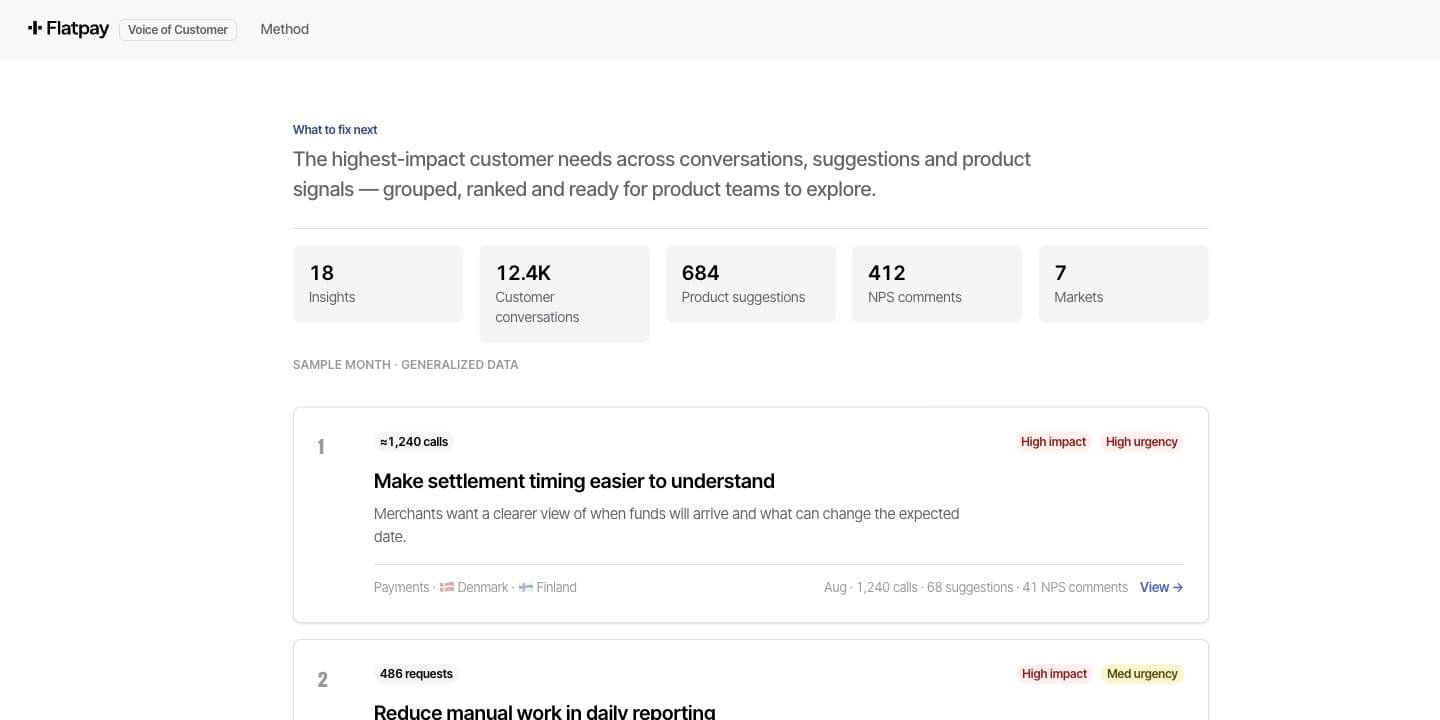
Customer centricity had to become a practice rather than a sentiment. We established standardized UX research and AI-enabled Voice of Customer processes, and introduced product-behaviour analytics and customer-satisfaction tracking. That brought support calls, retention conversations, sales visits, NPS, BI and product data into the same decision-making environment.
This foundation made the next phase possible. The AI transformation work at Flatpay is not a separate innovation programme. It extends the same idea: give teams better context, better systems and more room to use their judgement well.
The work continues
The organisation is still growing, and the work is still changing. We have supported 4× year-on-year ARR growth, approximately 12–15% month-on-month growth, and a rise in global product NPS from 25 to more than 55. Those outcomes matter, but the more durable result is a product organisation with a clearer strategy, stronger feedback loops and more people able to make the decisions that move the company forward.